AHSYNC BYTES - Weekly Digest (16th Mar, 2026)
From Meta’s MTIA chips to Google’s "Groundsource" AI weather modeling, the frontier of tech is moving fast. We analyze the bridge to TypeScript 7.0 and how to scale Angular apps using Native Federation. A concise roundup for builders focused on performance, security, and high-scale infra.
Hey builders 👋
Welcome to this week’s edition, your curated roundup of what’s shaping the future of tech. From breakthroughs in AI & Machine Learning to the latest updates in Angular and the ever-evolving Web & Frontend ecosystem, we’ve filtered the noise so you don’t have to. Let’s dive into the trends, tools, and updates that matter most.
🤖 AI & Machine Learning
Plan Mode is Now Available in Gemini CLI
Plan mode is a read-only mode that restricts Gemini CLI to a subset of its tools. When active, the agent can navigate your codebase, search for patterns, and read documentation, but it cannot modify any files except for its own internal plans.
You can ask Gemini CLI to "research how to migrate this database" or "plan a new feature," and it will map out the dependencies and propose a solution without risk of eager code changes.
 Jerop Kipruto
Google is Using Old News Reports and AI to Predict Flash Floods
Flash floods are among the deadliest weather events in the world, killing more than 5,000 people each year. They’re also among the most difficult to predict. But Google thinks it has cracked that problem in an unlikely way — by reading the news.
While humans have assembled a lot of weather data, flash floods are too short-lived and localized to be measured comprehensively, the way the temperature or even river flows are monitored over time. That data gap means that deep learning models, which are increasingly capable of forecasting the weather, aren’t able to predict flash floods.
To solve that problem, Google researchers used Gemini — Google’s large language model — to sort through 5 million news articles from around the world, isolating reports of 2.6 million different floods, and turning those reports into a geo-tagged time series dubbed “Groundsource.” It’s the first time that the company has used language models for this kind of work, according to Gila Loike, a Google Research product manager. The research and dataset was shared publicly Thursday morning.
 Tim Fernholz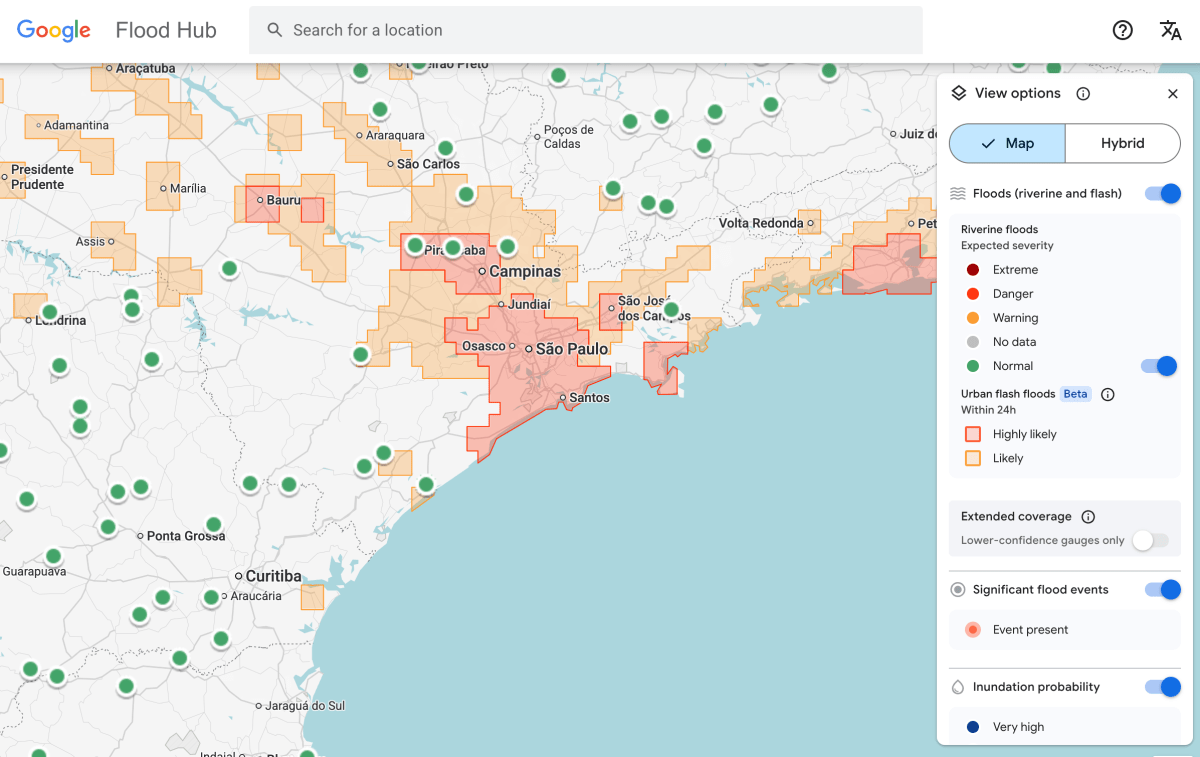
Meta Announces Four New In-House AI Chips to Reduce Reliance on Nvidia
Meta revealed four new generations of custom AI chips, the MTIA 300, 400, 450, and 500, to be deployed across its data centers by end of 2027. Designed to power everything from content ranking and recommendations to high-end generative AI inferencing, the chips aim to reduce Meta's dependence on external vendors and cut costs.
The MTIA 400 is already in testing and claims to offer performance competitive with leading commercial products, while the 450 and 500 are scheduled for mass deployment in 2027. Read more!

Unleash Your Development Superpowers: Refining the Core Coding Experience
Here on the Gemini Code Assist team, our primary goal is to make the moment-to-moment experience of writing and reviewing code more fluid, intelligent, and productive. We believe that a great developer tool gets out of your way while offering powerful assistance right when and where you need it.
This post highlights recent feature additions and improvements that enhance your core coding workflow. From writing the first line of a function to navigating your project, these updates are designed to keep you in a state of flow and help you produce high-quality code faster.
 Divyansh Chaturvedi
🚀 Angular
Security in Angular Applications – What Every Developer Should Know
Security is one of the most important aspects of today’s IT world. At a time when data, know-how, or application source code may be worth millions of dollars, protecting systems is no longer an optional extra, but a necessity.
As Angular developers, do we need to pay special attention to this? Can such a large and advanced framework as Angular do everything for us?
In this article, Author will present the most important threats that may affect Angular applications and refer to recent vulnerabilities detected both in Angular itself and in libraries published in the npm ecosystem.
Angular is often regarded as a secure framework out of the box, and it does indeed offer many protection mechanisms. The problem appears when we choose to disable them ourselves.
 Mateusz Basiński
Angular Templates: Interpolation vs. Property Binding, What’s the Difference?
In this article, Author breaks down how the Angular compiler handles these syntaxes differently, explaining that while interpolation is designed for rendering data as text, property binding is the essential choice for passing non-string data types like objects, arrays, and booleans. It’s a quick but fundamental read for any developer looking to write cleaner, more intentional template code. Read more!

How to Use Micro Frontends Without Regretting It
Your Angular app has ballooned into a beast — builds drag on forever, deployments become team-wide nightmares, and everyone’s stuck waiting on each other. It’s like cooking a feast for 20 in a cramped kitchen: one slow chopper holds up the line. We’ve all been there.
Micro frontends flip that script, especially in Angular. They carve your giant app into smaller, independent chunks that teams can build, test, and deploy solo — like Netflix doling out UI pieces without the mess. Angular’s Native Federation makes it seamless: ditch webpack woes for ES modules that share dependencies and lazy-load on demand. Read more!
 Karol Modelski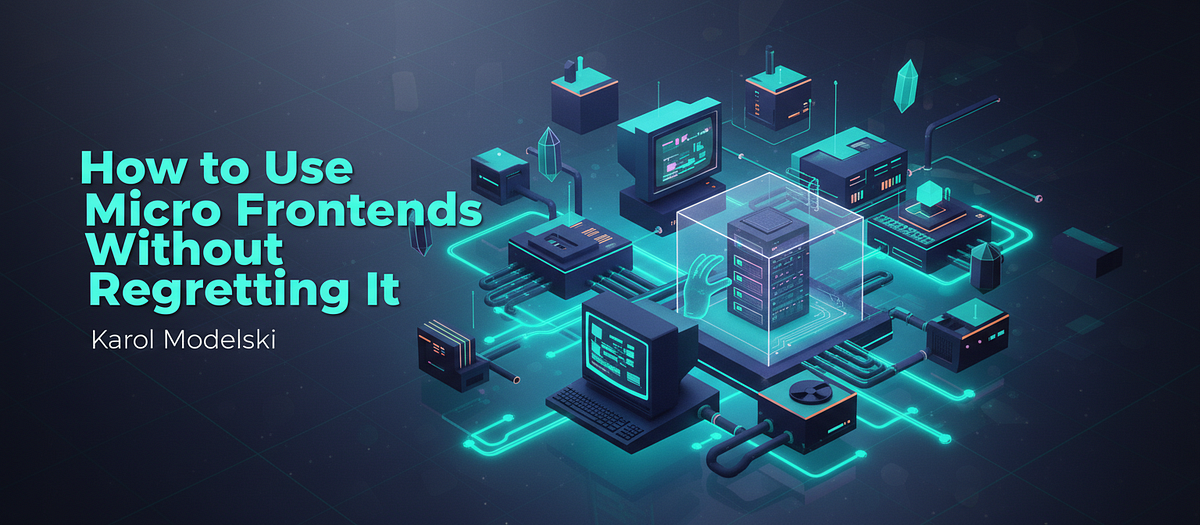
Upcoming Events
- JavaScript & Angular Days: March 20-24 2026 - Munich, Germany (and Online)
- International JavaScript Conference: May 11–15, 2026 - London, UK
- Angular Day: will be held in 2026, Get notified yourself!





🌐 Web & Frontend
My Next.js 16 Full Stack Crash Course (React 19 & Prisma)
Ready to master full-stack web development? In this complete Next.js crash course, you will learn how to build and deploy a production-ready application from scratch.
We are moving past basic React and diving deep into Next.js 16, building a real-world "Agent Skills Manager" app. You'll learn essential enterprise-level concepts like App Router, file-based routing, and the differences between SSG, SSR, ISR, and CSR. By the end of this video, you will have a fully functional, authenticated app deployed live on Vercel.
What you will learn & use:
- Next.js 16 & React 19 Fundamentals
- Prisma ORM & PostgreSQL for Database Management
- Tailwind CSS & DaisyUI for rapid styling
- Persistent Authentication with Cookies
- Deploying to Vercel for Production
Setting Up a Google Colab AI-Assisted Coding Environment That Actually Works
In this article, you will learn how to use Google Colab’s AI-assisted coding features — especially AI prompt cells — to generate, explain, and refine Python code directly in the notebook environment.
Topics we will cover include:
- How AI prompt cells work in Colab and where to find them
- A practical workflow for generating code and running it safely in executable code cells
- Key limitations to keep in mind and when to use the “magic wand” Gemini panel instead
Let’s get on with it.
 Iván Palomares Carrascosa
Announcing TypeScript 6.0 RC
TypeScript 6.0 is a unique release in that we intend for it to be the last release based on the current JavaScript codebase. As announced last year (with recent updates here), we are working on a new codebase for the TypeScript compiler and language service written in Go that takes advantage of the speed of native code and shared-memory multi-threading.
This new codebase will be the foundation of TypeScript 7.0 and beyond. TypeScript 6.0 will be the immediate precursor to that release, and in many ways it will act as the bridge between TypeScript 5.9 and 7.0. As such, most changes in TypeScript 6.0 are meant to help align and prepare for adopting TypeScript 7.0.
With that said, there are some new features and improvements that are not just about alignment. Let’s take a look at some of the highlights of this release, followed by a more detailed look at what’s changing for 7.0 and how to prepare for it.
To get started using the RC, you can get it through npm with the following command:
npm install -D typescript@rc Daniel Rosenwasser
Upcoming Events
- GitHub at RSA 2026: March 23-26, 2026 - San Francisco, California
- ConFoo Montreal 2026: February 25-27, 2026 - Montreal, Canada. Visit Site
- Frontend Nation: Comming in 2026! Free Online Live Event



💡 Bottom Line Up Front
The March 16, 2026, edition of AHSYNC BYTES highlights a pivotal shift toward "safe" AI autonomy and high-performance infrastructure. Google has introduced Plan Mode for Gemini CLI to allow codebase research without unintended side effects, while simultaneously leveraging LLMs to fill critical historical data gaps in flood prediction. Meanwhile, Meta is aggressively scaling its internal hardware with four new generations of custom AI chips to decrease its long-term reliance on external vendors like Nvidia.
In the development ecosystem, structural modernization is the primary theme. TypeScript 6.0 RC has been positioned as the final bridge before a complete Go-based rewrite in version 7.0, promising massive performance gains through native code. On the frontend, the focus remains on architectural discipline—spanning Next.js 16 and React 19 integrations, the security nuances of Angular templates, and the adoption of Native Federation to manage the complexity of micro-frontends without the historical overhead of Webpack.
I hope you find these helpful. If you do, please share our blog with others so they can join our amazing community on Discord (link below)

Don't miss out – join our awesome community to grow as a tech enthusiast, and to help others grow.
As always, Happy coding ❤️
Sponsor Us:
Promote your product to a focused audience of 4400+ senior engineers and engineering leaders.
Our newsletter delivers consistent visibility among professionals who influence technical direction and purchasing decisions.
Availability is limited. Secure your sponsorship by contacting ahsan.ubitian@gmail.com