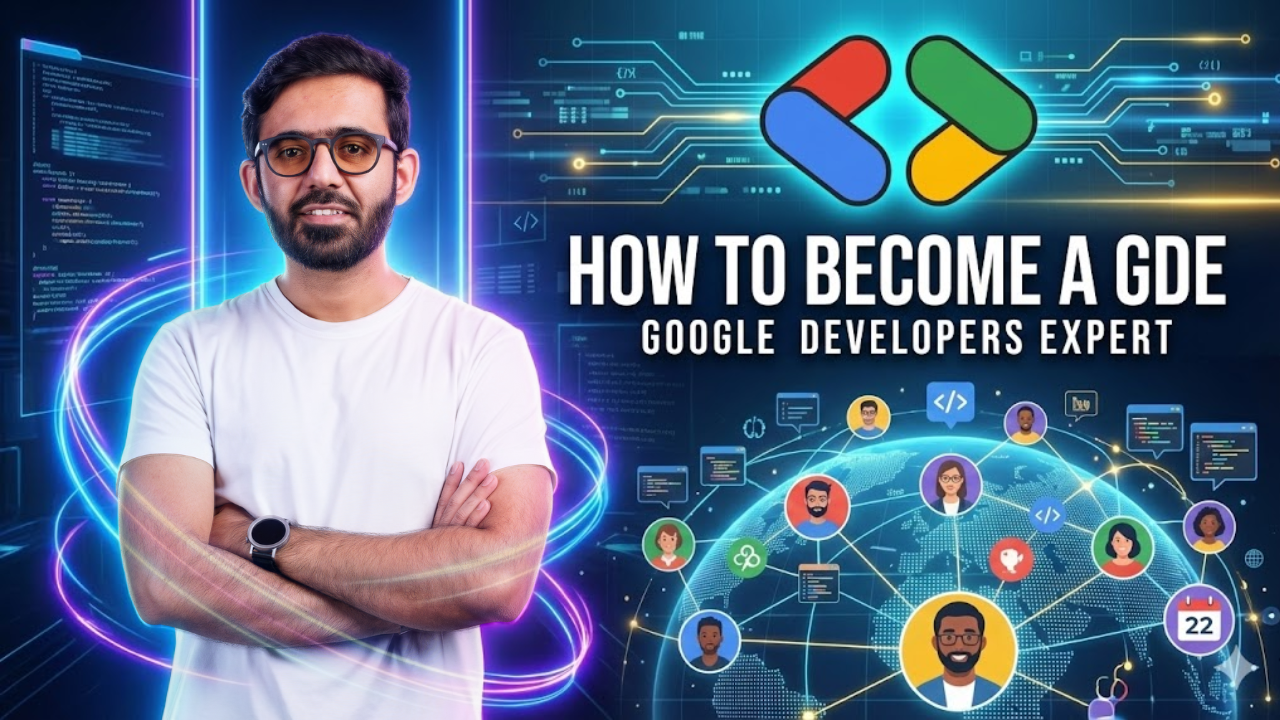
How to Become a Google Developer Expert (GDE): The Complete Guide
A GDE's insider guide to the Google Developer Expert program. Learn the nomination process, interview questions, activity tracking strategies, and how to stand out.

The Architect of Influence — A Definitive Roadmap
Part I: The Philosophy of Expertise and Program Dynamics
The Essence of the Google Developer Expert Program
In the sprawling, chaotic, and ever-evolving landscape of global technology, the Google Developer Expert (GDE) program stands as a beacon of validated authority. It is not merely a certification that one studies for and passes; rather, it is a recognition of a professional state of being. The program identifies and elevates individuals who have achieved a symbiotic mastery of Google technologies and a profound commitment to the developer community.
These are professionals who do not just build in silence but who vocalize their learnings, democratize their discoveries, and actively lift the ecosystem around them. It is a distinction awarded to those who serve as the bridge between Google’s engineering teams in Mountain View, Zurich, or New York, and the millions of developers worldwide using their tools.
Understanding the program requires dispelling the most common misconception: GDEs are not Google employees. They are strictly independent professionals—they could be CTOs of startups, freelance consultants, Senior Engineers at major enterprises, or agency founders. This independence is crucial. It gives their advocacy credibility. When a GDE recommends a specific architecture using Firebase or Cloud Run, the audience knows this advice is born from battle-tested experience in the real world, not from a corporate script. The program, therefore, is an elite network of thousands of professionals globally who have demonstrated not just technical competence, but the "Googliness" required to mentor, teach, and inspire.
The journey to becoming a GDE is often described not as a sprint, but as a career-altering marathon.

It transforms a developer's trajectory, moving them from a participant in the tech economy to a leader within it. The benefits of this transformation are tangible and immense, creating a flywheel effect where access to resources allows for better work, which leads to greater recognition, which in turn unlocks further opportunities.
The Value Exchange: Analyzing the Benefits Ecosystem
The GDE program operates on a model of mutual exchange. Google provides experts with resources, access, and status; in return, experts provide the community with guidance, feedback, and advocacy. This relationship is structured around a tier of benefits that are designed to keep the expert at the bleeding edge of innovation, ensuring they remain the most knowledgeable person in the room.
Table 1: Strategic Analysis of GDE Program Benefits
| Benefit Category | Specific Allocation | Strategic Implication for the Expert |
|---|---|---|
| Direct Access | Product Team Collaboration | Experts often have direct lines to the engineering teams building the tools they use. This means a GDE can influence the product roadmap, reporting bugs or requesting features with a weight that an average user lacks. |
| Technical Enablement | Early Access Programs (EAPs) | GDEs frequently receive access to Alpha and Beta versions of software (e.g., AI Studio early previews, new Firebase features). This allows them to prepare talks and articles before a public launch, positioning them as immediate thought leaders on "day one" of a release. |
| Financial Support | Cloud & AI Credits | The program provides substantial infrastructure support, including Google Cloud credits, specific stipends for Generative AI development , and access to Firebase Studio workspaces. This removes the financial barrier to experimentation, allowing experts to build complex demos without personal cost. |
| Professional Growth | Summit Invitations | Access to the annual GDE Summit (often held in major tech hubs like Mountain View, Toronto, or Krakow) provides a high-density networking environment. This is an all-expenses-paid opportunity to connect with peers who are also at the top of their fields. |
| Certification | Vouchers & Training | Experts sometimes receive vouchers for Google Cloud certifications and unlimited access to over 700 labs and courses. This ensures that their formal credentials remain impeccable without out-of-pocket expenses. |
| Tooling | Software Licenses | Benefits include subscriptions to tools like Gemini Code Assist and JetBrains IDEs, streamlining the actual workflow of coding and content creation. |
These benefits are not merely perks; they are tools of the trade. The cloud credits allow an expert to spin up a Kubernetes cluster to demonstrate a scaling principle during a workshop. The early access allows an expert to write the definitive blog post on a new Android lifecycle event the moment the embargo lifts. The travel support enables an expert to speak at a conference in a different continent, expanding their personal brand globally. Thus, the benefits fan the flames of the expert's impact.
The Tenure Model and Active Status
It is critical to understand that "GDE" is an active status, not a lifetime achievement award. The program requires continuous contribution. An expert must demonstrate, usually on an annual basis, that they are still contributing to the ecosystem. If an expert stops speaking, writing, or mentoring, they are moved to "Alumni" status. This tenure model ensures that the directory of experts remains dynamic and relevant. It prevents the title from becoming stale and ensures that anyone currently holding the badge is actively engaged with the current state of the technology. This creates a healthy pressure: to remain a GDE, one must remain a student of the craft and a servant of the community.
Part II: The Mental Model and Strategic Preparation
The "Fireship" Philosophy: Mindset Over Metrics
One of the most articulate voices on the path to becoming a GDE is Jeff Delaney, the creator of the Fireship channel and a GDE for Firebase. His journey and advice provide a critical framework for aspiring experts, emphasizing that the "how" is less important than the "why." Jeff argues that many developers approach the program with the wrong goals: they want internet fame, viral videos, or a massive Twitter following. While these metrics can be byproducts of success, they are poor primary objectives.
The correct mindset, according to this philosophy, is rooted in utility. The goal should be to be "unbelievably helpful" to other developers. Whether a video gets 500 views or 500,000 views is secondary to the quality of the insight provided to those who watch it. The aspiring GDE must shift their internal narrative from "I need to be famous" to "I need to solve this specific problem for my peers." This authenticity is what Google looks for. They are adept at spotting "career climbers" versus "community builders." The former are often rejected; the latter are embraced.
This mindset shift involves defining a Mission. A candidate should not just be a "Web Developer." They should be "The developer who is making Angular accessible to junior engineers in emerging markets," or "The engineer obsessed with Web Performance and Core Web Vitals." This specialization makes the candidate memorable. When the review committee looks at an application, they should immediately understand the candidate's specific value proposition to the ecosystem.

Strategic Niche Selection: The Major and The Minor
The GDE program is segmented into specific technology categories (e.g., Android, Google Cloud, Web Technologies, Machine Learning, AI, Firebase, Flutter, etc). A common strategic error is attempting to be a generalist. The program rewards depth.
- The Major: This is the primary technology where the candidate has deep, production-level expertise. For example, if one chooses Android, they must know the framework inside out—from the nuances of Jetpack Compose to the depths of memory management and the build system.
- The Minor: This is a secondary, often complementary skill that adds flavor to the expertise. For instance, an Android GDE might have a minor in AI/ML (On-device ML) or Firebase. This intersection is often where the most interesting content is created.
Choosing a niche also involves analyzing the "market density." Some categories, like broadly defined "Web Technologies," are incredibly competitive. Others, like Google Maps Platform, Google Pay, or specific subsets of Google Cloud (like Cloud Run or BigQuery), may have fewer experts, providing a strategic opening for a dedicated specialist to stand out quickly. For example, experts like Diana Rodriguez carved out a global reputation specifically by focusing on the Google Maps Platform, a niche that is critical but often less crowded than the general "JavaScript" space.
The Activity Roadmap: From Practitioner to Leader
The trajectory from zero to GDE typically spans 12 to 24 months of deliberate activity. This roadmap can be broken down into distinct phases of maturation.
Phase 1: The Builder (Months 1-6)
In this phase, the focus is entirely on technical competence and initial output. The candidate should be building real-world applications. Theoretical knowledge is insufficient; the expertise must be grounded in the trenches of production code.
- Action: Build a complex side project or work on sophisticated features in a day job using the target technology.
- Output: Start documenting the learning process. Write blog posts about the bugs encountered and how they were fixed. These don't need to be masterpieces; they need to be public logs of technical problem-solving.
Phase 2: The Teacher (Months 7-12)
Once technical confidence is established, the candidate must pivot to teaching. This is the core requirement of the GDE program.
- Action: Step out of the "user" role and into the "educator" role.
- Output: Submit proposals (CFPs) to local meetups. It does not matter if the audience is 10 people. I remember my first few sessions in Karachi, Pakistan. One of them was a workshop, and I had 3 people only 🙂 It was an hour and a half long workshop.
The practice of structuring a talk and delivering it is what counts. Simultaneously, increase the cadence of written content. Aim for one high-quality article per month.
Phase 3: The Leader (Months 13-18+)
To cross the threshold into GDE status, one must show leadership.
- Action: Don't just attend the meetup; organize it. Don't just use the open-source library; contribute a PR to it or maintain a fork.
- Output: Mentorship becomes key here. Answering questions on Stack Overflow, helping junior colleagues, or running workshops. This demonstrates the "community impact" metric that Google scrutinizes heavily.

Part III: The Infrastructure of Success – The Activity Tracking Sheet
One of the most practical and critical pieces of advice for any aspiring GDE is to treat their community work as a data project. When the time comes to apply, the application form will ask for links, dates, and metrics for activities over the past year or more. Relying on memory is a recipe for failure. A dedicated Activity Tracking Sheet is the GDE's most valuable administrative tool.
3.1 Architecture of the Tracking Sheet
The tracking sheet should be hosted on Google Sheets for obvious reasons: accessibility, shareability (with mentors), and programmability via Apps Script. The structure must be granular enough to capture the "Impact" of every action.
Table 2: Recommended Structure for GDE Activity Log
| Column Name | Data Type | Description & Strategic Importance |
|---|---|---|
| Date | ISO 8601 | The specific date of the activity. Crucial for demonstrating consistency over time (e.g., "Active every month for 18 months"). |
| Activity Type | Dropdown | Options: Speaking, Article, Video, Open Source, Mentoring, Organizing. Categorization helps you see if you are over-indexed in one area (e.g., too many blogs, not enough speaking). |
| Title / Topic | Text | The name of the talk or article. Should highlight the specific technology (e.g., "Optimizing Angular Change Detection"). |
| Link / Evidence | URL | Direct link to the recording, slide deck, published article, or GitHub PR. This is the "proof of work" Google reviewers will click. |
| Reach (Hard Numbers) | Integer | The number of attendees, views, reads, or stars. This is the "Impact" metric. Do not guess; log the actual data. |
| Location / Platform | Text | e.g., "DevFest Stockholm," "Medium," "YouTube," "Stack Overflow." Shows the breadth of your footprint. |
| Tech Tags | Text | e.g., #Android, #Kotlin, #GCP, #Gemini. Useful for filtering if you apply for a specific GDE category. |
| Qualitative Impact | Long Text | Quotes from attendees, feedback tweets, or anecdotes about how the content helped someone. This "soft data" is powerful in the interview. |

3.2 Automating the Portfolio with Apps Script
For the technically inclined (which, as a GDE candidate, you are), manually updating this sheet can be automated using n8n, cronjobs, or Google Apps Script. This not only saves time but serves as a portfolio piece in itself—a demonstration of proficiency with the Google Workspace developer ecosystem (if applicable).
Automation Workflow Examples:
- YouTube Integration: A script can be written to query the YouTube Data API. It can iterate through the rows of the sheet, identify rows with YouTube links, fetch the current view count and comment count, and update the "Reach" column automatically. This keeps the portfolio dynamic and up-to-date.
- Calendar Sync: A script can listen to a specific "Speaking Engagements" calendar in Google Calendar. When an event is added there, the script parses the metadata (date, title, location) and appends a new row to the tracking sheet. This ensures no event is ever forgotten.
- Portfolio Generation: Using tools like Document Studio or custom scripts, the data in this sheet can be merged into a Google Doc or PDF template. This allows the candidate to generate a polished "GDE Impact Report" PDF with a single click when asked by a nominator or interviewer.
3.3 The Concept of the "Impact Report"
The application form asks for evidence of impact. This is distinct from activity. Activity is "I gave a talk." Impact is "I gave a talk, and as a result, 15 developers in the audience refactored their codebases to use the new Navigation Component." By tracking the "Qualitative Impact" column in the spreadsheet, candidates build a repository of these stories. When writing the application, these anecdotes provide the color and depth that differentiate a great candidate from a good one.
Part IV: The Nomination Strategy – Entering the Circle
The GDE program is invite-only in the sense that you cannot simply click a "Submit" button on a website to start the process. You must be referred (nominated) by an existing GDE or a Google employee. This creates a high barrier to entry and emphasizes the importance of networking.
4.1 The "Don't Ask, Attract" Strategy
A common mistake is to cold-message GDEs asking for a nomination. This is often perceived as transactional and presumptuous. The GDE reputation is on the line when they nominate someone; they need to be sure of the candidate's quality.
The superior strategy is the "Audit Request." Instead of asking for a nomination, the candidate should approach a GDE with their Activity Tracking Sheet and ask for guidance.
- The Pitch: "I am working toward becoming a GDE in [Category]. I have logged my community work for the last 12 months in this sheet. Could you spare 10 minutes to review it and tell me where my gaps are?"
- The Psychology: This positions the candidate as humble and serious. It gives the GDE a low-stakes way to help. If the portfolio is impressive, the GDE will naturally offer to nominate the candidate. If it is not, the candidate receives valuable feedback without facing a rejection.

4.2 Navigating the Ecosystem: The Stockholm Case Study
To understand how to navigate this network, let us examine the ecosystem in Stockholm, Sweden, because I live here. But this serves as a model for any region.
In Stockholm, the GDE network is vibrant and interconnected. Key figures include:
- Ankur Roy: A Cloud GDE and Solutions Architect who speaks frequently on integrating Google Cloud with Workspace (e.g., using Firebase Studio).
- Mohammed Aboullaite: A Google Cloud GDE known for his amazing articles at https://aboullaite.me/ and speaking at international conferences.
- Vandad Nahavandipoor: A Flutter/Dart GDE who works at Pixolity AB and is the author of https://github.com/vandadnp/flutter-tips-and-tricks with over 6.9k stars on GitHub.
- Myself (Muhammad Ahsan Ayaz): A GDE in AI & Angular, author of 3 Angular books, creator of the famous Angular in 90 minutes crash course (~0.6 million views), and creator of ngx-device-detector (13 million npm installs & 5.5k+ projects on GitHub using it).
These experts congregate at specific hubs: GDG Stockholm (Android & Web) and GDG Cloud Stockholm. These groups host events like DevFest Stockholm, a massive annual conference.
The Tactical Approach for a Candidate:
- Presence: Attend these meetups consistently. Do not just show up; sit in the front, ask questions, and stay for the "mingle".
- Volunteer: Offer to help the organizers (who are often GDEs) with logistics. This builds trust.
- Speak: Propose lightning talks. Even a 5-minute demo puts the candidate on the radar of the organizers (the potential nominators).
- Connect: Once face-to-face rapport is established, send a follow-up email sharing the Activity Sheet and asking for the "Audit."
4.3 The Outreach Template
When the time is right to formalize the request for advice (and implicitly, nomination), the communication should be professional and evidence-based.
Subject: Seeking Mentorship: GDE Roadmap & Portfolio Review
Body:
Hi [Name],
It was great meeting you at last week. Your point about really clarified the issue I was having with my current project.
As I mentioned, I have been focusing heavily on contributing to the community over the past year. My long-term goal is to join the GDE program to further scale this impact.
I have compiled a log of my speaking, writing, and open-source contributions here: [Link].
I know you are busy, but if you ever have a brief moment, I would value your honest assessment. Do you feel this body of work is approaching the standard for a nomination, or should I focus on increasing my output in for the next few months?
Thank you for your leadership in our community.
Best regards,
This email is respectful, provides evidence, and asks for feedback rather than a favor.
Part V: The Application and Interview Gauntlet
Once a nomination is submitted, the candidate receives an invitation to apply. This kicks off a rigorous evaluation process consisting of an eligibility check and two distinct interview phases.
5.1 The Application Form
The application is the first filter. It requires the candidate to transfer the data from their Activity Sheet into Google’s system. The key here is to select the most impactful activities, not just the most recent. The "Impact" metrics (views, attendees) are critical data points that the internal review team uses to verify the reach of the candidate.
5.2 The Community Interview (Behavioral)
If the application passes the internal screen, the candidate is invited to the Community Interview. This is usually conducted by an active GDE from a different region to ensure impartiality.
Objective:
The interviewer is assessing "Googliness," cultural fit, and communication skills. They want to know if the candidate is a kind, helpful, and articulate representative of the community.
Key Behavioral Questions & Strategy:
- "Why do you want to be a GDE?"
- Trap: "It will look good on my resume."
- Strategy: Focus on service. "I want to amplify my ability to help others. Being a GDE gives me better access to information that I can pass on to the junior developers I mentor".
- "Tell me about a conflict in a community setting."
- Trap: Blaming others or getting into technical arguments.
- Strategy: Use the STAR method (Situation, Task, Action, Result). Describe a disagreement (perhaps about a Code of Conduct issue or a technical debate), explain how you listened, found common ground, and de-escalated the situation professionally.
- "How do you handle a beginner asking a 'bad' question?"
- Strategy: Demonstrate empathy. Explain that there are no bad questions, only opportunities to teach. Describe how you guide them to the solution rather than giving it to them or dismissing them.
5.3 The Product Interview (Technical)
The final stage is the Product Interview, conducted by a Google employee (typically a Developer Advocate or Product Manager). This is a comprehensive technical exam. Mine was taken by Stephen Fluin about 8 years ago, who back then was one of the public faces of the Angular team.

Objective:
To verify that the candidate’s expertise is deep, accurate, and aligned with Google’s best practices. A GDE is trusted to give advice; that advice must be correct.
Technical Deep Dives by Domain:
Domain A: Angular
Candidates must demonstrate they are not just users of the framework, but understand its internal evolution and architectural shifts.
- Signals vs. Zone.js: "Compare the change detection mechanism in a Zone.js application versus a Zoneless application using Signals. How does the propagation of updates differ?" Expect to discuss the fine-grained reactivity graph, how
OnPushcompares to Signal-based updates, and the performance implications of monkey-patching browser APIs. - Dependency Injection & Architecture: "Explain the resolution hierarchy when using
providedIn: 'root'versus providing a service in a component'sprovidersarray. How does the moderninject()function change how we test and compose logic?" Discussion should coverElementInjectorvsModuleInjectorand tree-shaking implications. - Performance & Hydration: "How does the
@deferblock work under the hood regarding hydration? When would you useon interactionversuson viewport?" The candidate should explain incremental hydration and how deferred block dependencies are chunked and loaded only when triggered.
Domain B: Generative AI (Google AI Studio)
The focus is on architectural decision-making, cost-optimization, and prompt engineering strategies.
- Context Caching vs. RAG: "When designing a solution for a 'Chat with your Data' app with static documents, when would you choose Gemini's Context Caching over a traditional RAG architecture?" The answer requires analyzing token costs, latency (caching is faster for repeated queries), and the 1M+ token window capability.
- Structured Outputs: "Explain the difference between using System Instructions for formatting versus using Function Calling (Tools). In what scenario is Function Calling strictly necessary?" Discussion should cover how the model "decides" to call a tool versus simply formatting text as JSON.
- Multimodality: "How does Gemini handle video input in the context window compared to text, and what are the implications for your token budget?" Candidates should understand that video is tokenized as a sequence of frames/images and consumes the context window significantly faster than text.
Domain C: Web Technologies
- Performance: "How do you optimize Core Web Vitals (LCP, CLS, FID)?" Discuss lazy loading, critical CSS, and image optimization formats (WebP/AVIF).
- Capabilities: "Explain the capabilities of Project Fugu." Discuss how web apps can access native hardware like Bluetooth or the file system.
The "I Don't Know" Protocol:
Crucially, if a candidate does not know an answer, they should admit it. "I am not 100% sure on that specific API, but here is how I would find the answer..." is a passing answer. Guessing or bullshitting is an automatic fail. The interviewer is testing the boundaries of the candidate's knowledge.
Part VI: Post-Acceptance and Future Outlook
Upon passing the Product Interview, the candidate signs the NDA and officially becomes a GDE. They are onboarded into the directory and gain access to the private Slack channels, summits, and mailing lists.
However, the work does not stop. The "Tenure" model means the clock starts ticking immediately for the next year's renewal. The new GDE must continue to log activities in an internal GDE platform. The difference is that now, their impact is amplified. They are no longer just a developer; they are a recognized leader, responsible for shepherding the next generation of experts into the fold.
Conclusion: The Call to Action
Becoming a Google Developer Expert is a path of high resistance but high reward. It requires a fundamental shift in how one views their career—from a series of jobs to a platform for service.
The "Next Monday" Action Plan:
- Create the Spreadsheet: Copy the structure from Part III and initialize it today.
- Backfill Data: Populate the last 6-12 months of activity.
- Audit: Look at the data objectively. Where is the gap? (Speaking vs. Writing vs. Code).
- Engage: Find the next DevFest or GDG meetup in the region. Register not just to attend, but to volunteer.
- Build: Start the next side project or article series that defines the "Major" niche.
The badge is waiting. The community is waiting. It is time to do the work. All the best.
~ Ahsan